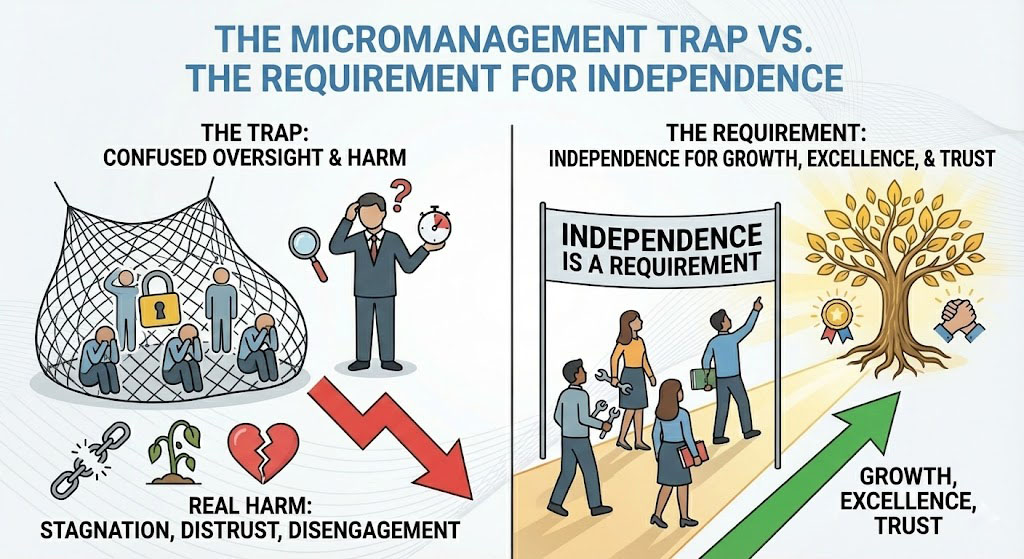
In a senior role, I have come to realize that adherence to my personal way of working is irrelevant, provided the work meets our shared standards of excellence. Yet many organizations fall into the trap of micromanagement, not always because people want control for its own sake, but because authority is confused with constant oversight and a reactive need to monitor progress in the absence of a long-term strategy. In my experience, this approach causes real harm. Independence is not a luxury at work, it is a requirement for growth, excellence, and trust.
When people are given the independence to do their work in their own way, something important happens. They stop performing for approval and start performing for results. Instead of spending energy trying to decipher shifting goalposts and inconsistent requirements, they focus on using their skills, judgment, and creativity to solve real problems. That shift alone can dramatically improve both quality and efficiency.
A couple of weeks ago, our team was given last-minute instructions on a project we were expected to lead, without having been asked for input. Almost immediately, most of us realized the plan was shortsighted, and we tried to help improve it, but we were told to proceed in practically the original manner we’d been presented with. The next morning, I was impressed and inspired by two coworkers who had taken the initiative on their own and delivered a far superior product than the one that had been prepared for us, demonstrating independent problem-solving, proactive leadership, and the ability to achieve results despite a starting plan that prioritized immediate activity over strategic foresight.
Micromanagement pulls attention in the opposite direction. I have seen capable people slow down, second-guess themselves, and disengage, not because they lack ability, but because every decision feels temporary. When expectations fluctuate based on the pressure of the moment, the safest strategy becomes compliance rather than excellence. Over time, people stop thinking independently. They wait to be told what to do, even when they know a better way forward.
The consequences are far from subtle: micromanaged environments breed frustration and burnout, and high performers often feel constrained and are more likely to leave. Those who stay often do the bare minimum required to avoid criticism. Innovation drops because risk is punished. Accountability weakens because ownership is unclear. When control exists at every step, responsibility becomes blurred, success is claimed upward, and failure is shared downward.
Trust changes this dynamic completely. When people are trusted with independence, it does not mean oversight disappears. It means the focus shifts from controlling behavior to supporting outcomes. Trust signals confidence in someone’s competence and intent. It invites ownership instead of compliance. In practice, people rise to that trust more often than they fail it. They plan better, communicate earlier, and take responsibility when things go wrong.
This does not mean the absence of structure. Independence only works when boundaries are clear. Standards matter. Expectations must be explicit. Accountability must be real. In a senior role, the responsibility is to define what success looks like, set constraints where they are genuinely needed, and provide real guidance and support. It is not to dictate every process or method, especially when the person doing the work understands the details better.
This often requires resisting the urge to correct how something is done when the outcome meets the standard. It means allowing approaches that differ from personal preference. It means accepting that discomfort is part of growth, both for the individual and for those in senior positions. Control feels safe in the short term, but it creates fragility over time.
Micromanagement often comes from good intentions. People want consistency, quality, and predictability. Ironically, excessive control undermines all three. Consistency becomes artificial. Quality becomes superficial. Predictability disappears as engagement drops and turnover rises. Independence, paired with clear expectations, produces more reliable results because it builds real capability instead of dependency.
For those working under micmanaging conditions, the impact is personal. Confidence erodes. Motivation fades. Work becomes about avoiding mistakes instead of creating value. Over time, people either shrink themselves to fit the system or remove themselves from it entirely. Neither outcome benefits the organization.
The most effective workplaces I have seen are not built on tight control, but on clarity, trust, and respect for professional judgment. When goals are clear and accountability is fair, people do not need constant supervision to perform well.
The longer I work in a senior role, the more convinced I am of this. Independence is not something to fear or tightly ration. It is a deliberate choice that strengthens people and the systems they work in. When individuals are trusted to work in their own way, within clear standards and accountability, they do more than complete tasks. They grow, they excel, and they contribute to something sustainable.
The benefits of independence and the costs of micromanagement are not just anecdotal; decades of research in psychology, organizational behavior, and management science provide clear evidence for why autonomy drives performance and engagement.
Grounded in research
-
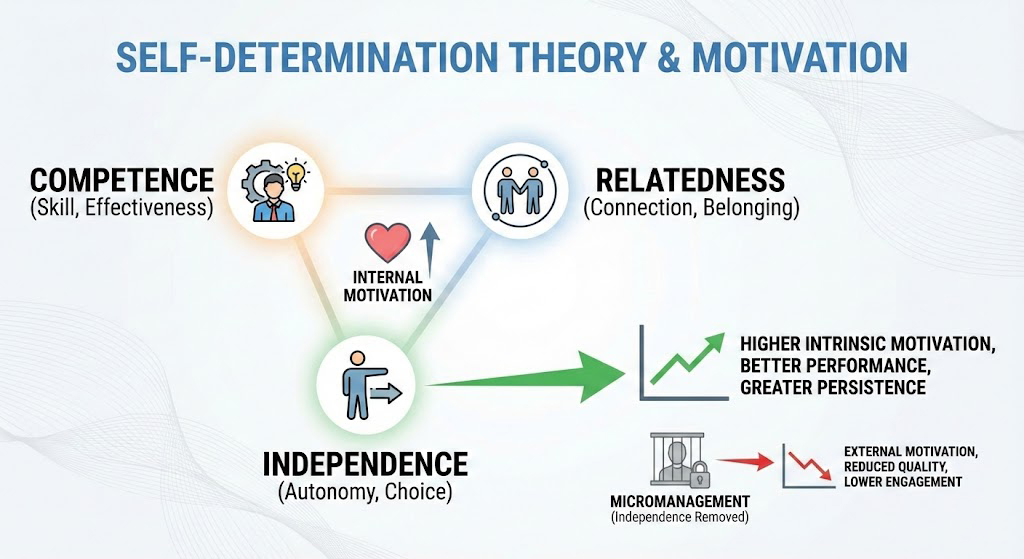 Self determination theory and motivation
Decades of research show that people are more motivated, engaged, and effective when three psychological needs are met, competence, relatedness, and independence. Independence in how work is performed consistently predicts higher intrinsic motivation, better performance, and greater persistence. When independence is removed through micromanagement, motivation shifts from internal to external, which reduces quality of work and long-term engagement. -
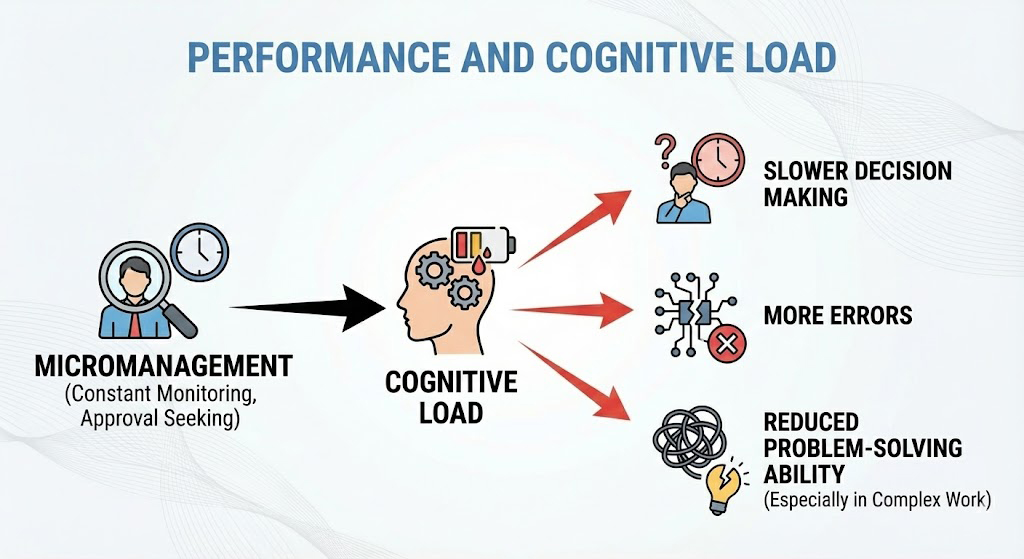 Performance and cognitive load
Micromanagement increases cognitive load. When people must constantly monitor how their actions will be perceived rather than focusing on the task itself, working memory is consumed by self monitoring and approval seeking. Studies show this leads to slower decision making, more errors, and reduced problem-solving ability, especially in complex work. -
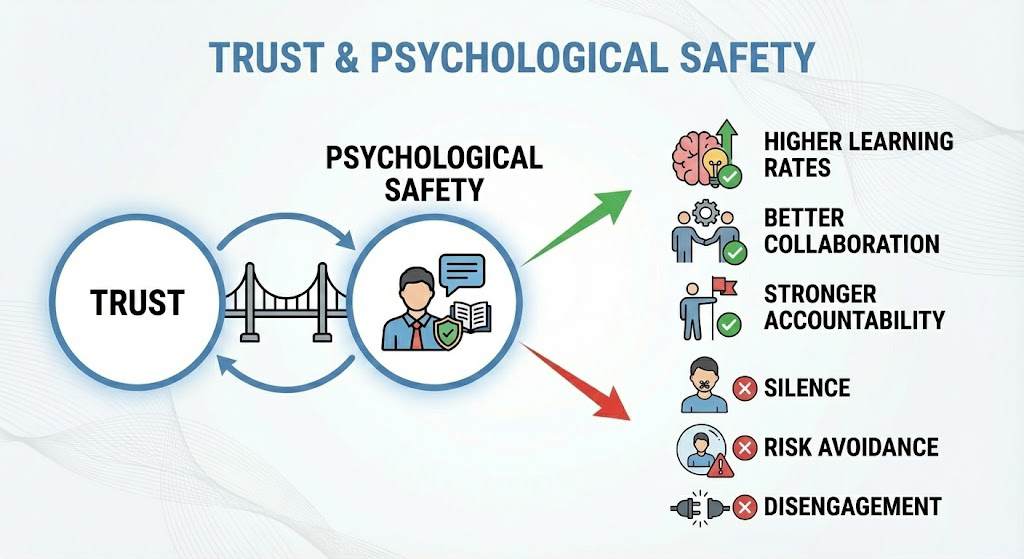 Trust and psychological safety
Research on psychological safety shows that people perform better when they believe they can act independently without fear of punishment for reasonable mistakes. High trust environments correlate with higher learning rates, better collaboration, and stronger accountability. Low trust environments lead to silence, risk avoidance, and disengagement. -
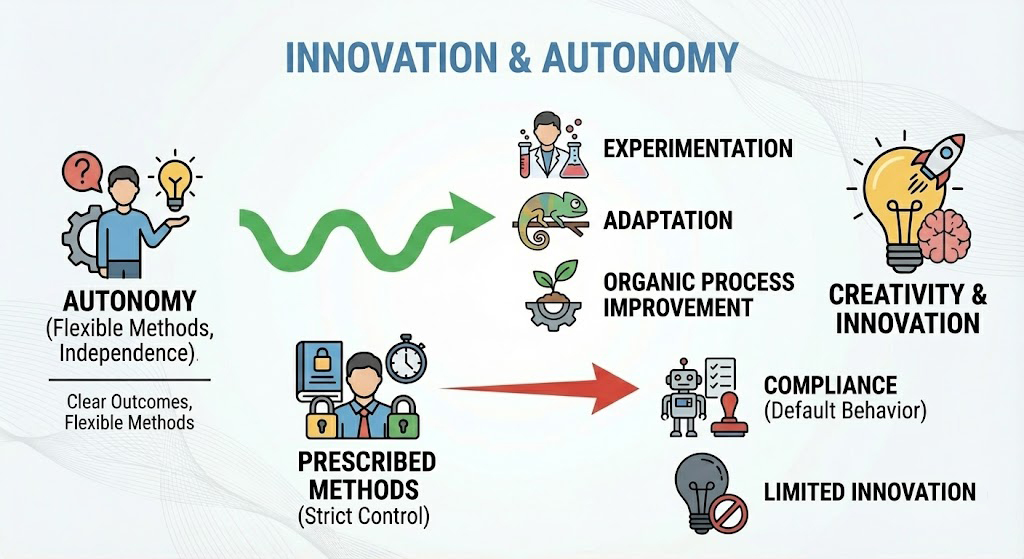 Innovation and autonomy
Multiple studies in organizational behavior show that independence in task execution is one of the strongest predictors of creativity and innovation. When methods are prescribed too tightly, people default to compliance. When outcomes are clear but methods are flexible, people experiment, adapt, and improve processes organically. -
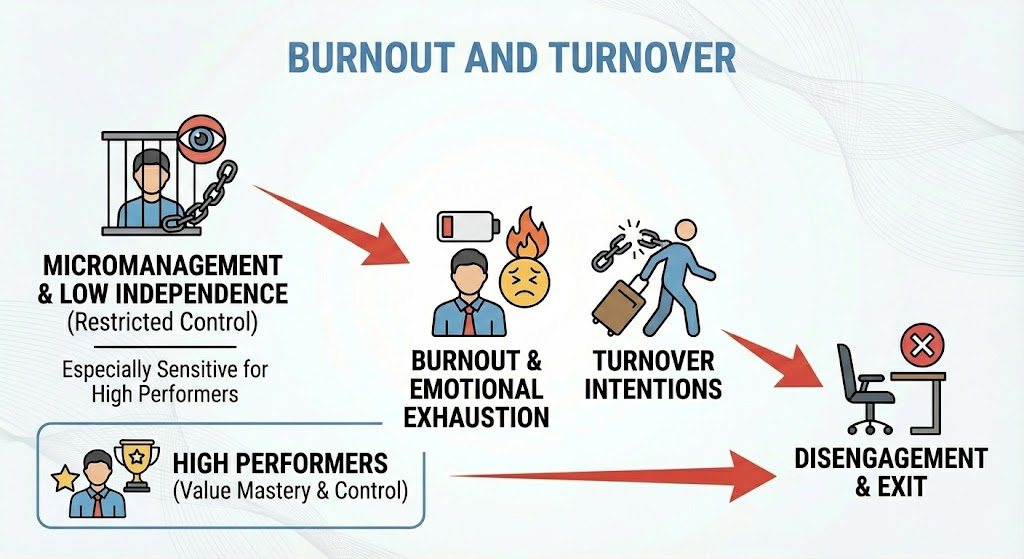 Burnout and turnover
There is clear evidence linking micromanagement and low independence to burnout, emotional exhaustion, and turnover intentions. High performers are especially sensitive to this because they tend to value mastery and control over their work. When that is restricted, they are statistically more likely to disengage. -
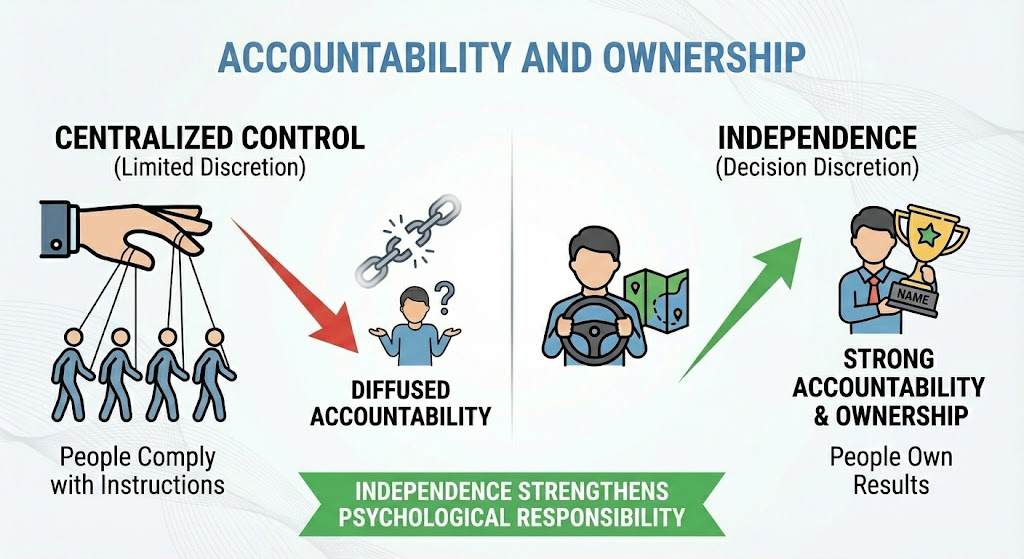 Accountability and ownership
Research consistently shows that people take greater responsibility for outcomes when they have discretion over decisions. When control is centralized, accountability diffuses. People comply with instructions rather than owning results. Independence strengthens accountability because people feel psychologically responsible for what they chose to do. -
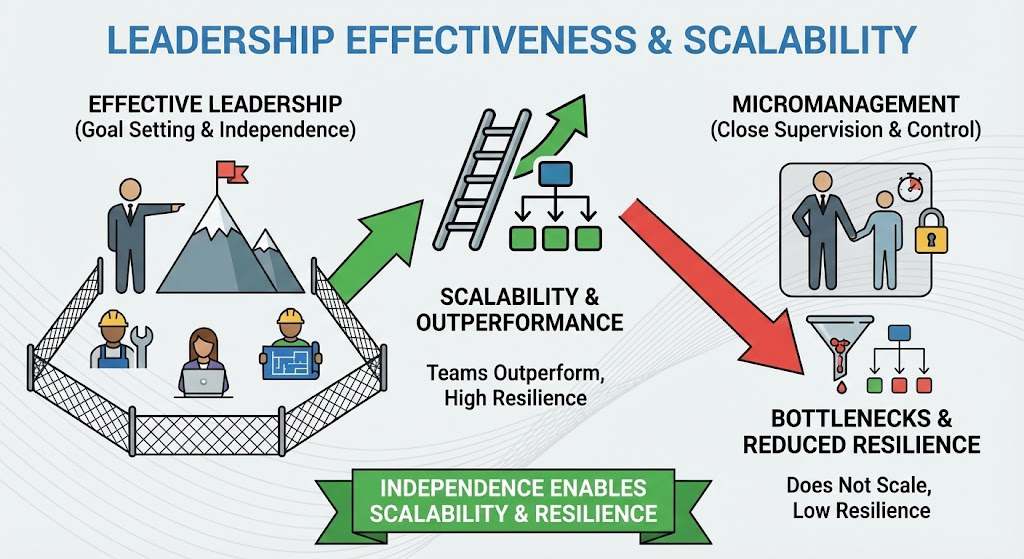 Leadership effectiveness and scalability
Management studies show that leaders who focus on setting goals, standards, and constraints, while allowing independence in execution, lead teams that outperform those led through close supervision. Micromanagement does not scale; it is frequently a byproduct of using oversight as a substitute for a clearly defined long-term roadmap.
Bottom line, grounded in science.
The evidence is clear. Independence improves motivation, performance, learning, innovation, accountability, and retention. Micromanagement degrades all of them. Structure, standards, and guidance are still necessary, but science consistently shows that controlling methods instead of outcomes produces weaker results.